


SHOP
It’s open!
Lego® Technic
In our store at Kosciuszko 47 you can buy dozens of different sets from the Technic series. In addition to the sets currently in distribution, you can also choose something for yourself from more than a dozen of older sets that are no longer in the LEGO® sale.
The Technic series is my specialty, I sell sets only from this series, but I focus on a selection you won’t find in most stores and on professional advice.
Check it out for yourself!
VIP Card to the World of Small Technicians
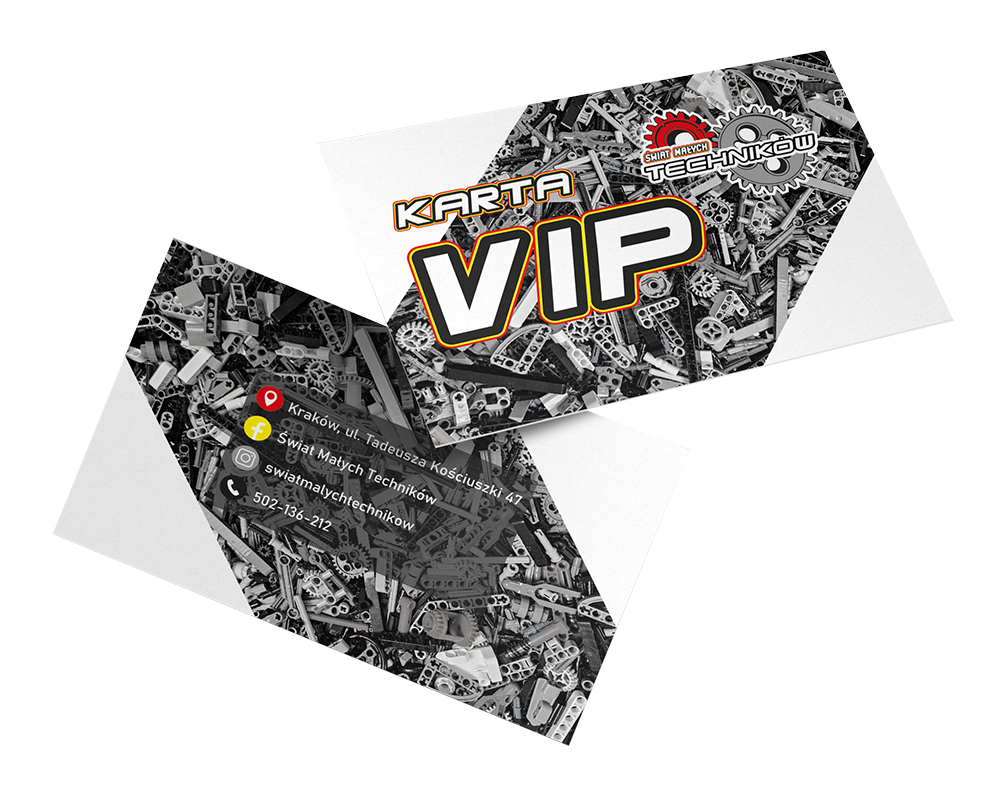
VIP Card to the World of Small Technicians
Personalized VIP Card with a unique number in addition to discounts will allow you to receive information about special offers, attractions and events from the World of Small Technicians.
LEGO® Technic - a brief history of the series
The LEGO® Technic series, to which this exhibition is entirely devoted, was launched in 1977. To me, it stands as a testament to the endless possibilities of combining play and science, in this case engineering and mechanics. Over the years, this iconic series has undergone a remarkable evolution, reflecting the advances in technology happening simultaneously in the real world, sparking the imagination of young and adult Technicians.

The birth of LEGO Technic (1977-1985).
The series debuted under the name „Expert Builder.” Perhaps that’s why sets in the series were sold for ages 9 and up. The first sets (to me a perfect foreshadowing of what the series would become) included a forklift, tractor, helicopter, auto chassis and a mobile crane. All of these models can be seen at the exhibition. After seven years, the name of the series was changed to „Technic” and, except for a logo change in 1999, it has remained that way ever since.
The emerging series introduced such new elements as beams, gears and axles, providing the basis for more complex and functional models. The flagship set at that time, Auto Chassis 853, laid the foundation for the Technic line’s focus on realistic mechanisms.
So today – as with the first sets – they are mostly models of machines or vehicles. They differ from those used in the System series, for example, because, thanks to other parts, the models have mechanisms similar to those found in everyday life, such as engine, suspension, pneumatic or transmission components.
While the first sets contained literally a handful of these parts in addition to the standard bricks known from other series, over time the series began to differ more and more from the others, thanks to increasing specialization and more and more bricks dedicated specifically to it. Today it’s the other way around, Technic bricks are predominantly in the set, and those known from other series are a handful. As a result, the machines or vehicles have a very realistic look and are nothing like the first angular machines, which were shaped by „ordinary” blocks.
In subsequent years, the Universal or Excavator sets further expanded the possibilities, with pneumatics and electric motors becoming key elements. As in the first decade, so now we can see innovative ideas and continuous development of sets and parts.
Pneumatics and Power Functions elements (1986-2005)
The late 1980s and 1990s were a period of refinement and development of the series. The introduction of new-generation Pneumatics elements gave models a new level of functionality, enabling designers to create more realistic mechanisms.
The late 1990s also saw the appearance of Power Functions elements, including new electric motors and infrared control. This technological leap enabled builders to incorporate remote-controlled functions into their creations, opening up new possibilities for more complex and interactive models.

Mindstorms integration and advanced mechanics (2006-2015)
The 2000s ushered in a new era for the series with the integration with the Mindstorms series. This collaboration provided builders with programmable blocks, sensors and motors to create robots and automated mechanisms.
At this stage, the Technic series also focused on more complex and realistic models, from supercars to construction equipment. Cult sets, such as the mobile crane and bulldozer, showcased complex gear systems and realistic functions.


Convergence of technology with real world mechanics and licensed sets (2016-present)
In recent years, LEGO Technic has continued to evolve using available technologies. Smartphone integration has enhanced Technic models interactively. Bluetooth connectivity and app-based control systems have added a new dimension to play.
The series has also partnered with various automotive brands to create highly detailed, licensed kits, such as the Unimog U400, Bugatti Chiron, Land Rover Defender, Lamborghini Sián FKP 37 and VOLVO A60H hauler, to name a few. These sets not only provide an amazing building experience, but also showcase the wonders of real-world engineering on a small scale.
Today, the series is one of LEGO®’s main lines. Fortunately for me and other geeks, it continues and new sets are still being released. At the same time, it is one of the longest-running LEGO series in history, having celebrated its 40th anniversary in 2017.
The series, through which many future engineers probably started experimenting with mechanics, now consists of more than 500 sets and new ones keep coming. In the record years of 1999 and 2000, as many as 25 in each were released.
Today’s young and adult Technicians can build complex mechanisms found in real gearboxes, engines, steering systems or suspensions, while the smaller sets can be reached by Technicians as young as 7 years old.
The history of LEGO Technic is one of constant innovation, reflecting the ever-changing landscape of mechanical and engineering technology around us. From its humble beginnings as Expert Builder to its current status as a high-tech series, Technic invariably inspires Little and Big Technicians to experiment, explore and engineer, combining fun with real-world mechanics.
Isn't this a great way to develop their engineering passions?
1977
The Expert Builder Series debuts, introducing new components such as gears, axles and beams, and among the first models set, Car Chassis (853) is released. It provided a base that could be rebuilt into any car inspired by either real models or one's own imagination. The same year also saw the creation of the first helicopter in the series (852) The first electric motor to power models was also released (870).
1979
The premiere LEGO Technic Motorbike with Sidecar (857). This advanced design was also created by combining Technic elements with classic LEGO bricks. The model was so successful that it was reintroduced in 1980 in the US.
1980
The new Auto Chassis Kit (8860) replaced the 853 and improved it in almost every aspect, offering an impressive list of old features (piston engine, transmission, steering, adjustable seats) as well as new ones (working differential, rear independent suspension or folding seats).
1984
First-generation pneumatic system introduced.
1986
The Arctic Action "sub-series" was released and with-it LEGO® Technic figures. The 4 sets introduced a fun theme and were all part of the same story - the exploration of the Arctic
1988
Launch of the LEGO Technic Test Car (8865). At the time, it was the largest LEGO Technic car model, consisting of 900 pieces. The same year saw the premiere of the first airplane - the LEGO Technic Prop Plane (8855).
1989
Second generation pneumatics introduced
1994
The huge Super Car (8880) was released. Many still consider it one of the best sets of the series ever, and it's hard to disagree with them. Supercar kits would henceforth include realistic features such as working steering, transmission, suspension system and opening doors.
1996
Release of LEGO Technic Space Shuttle (8480) the first space-themed model in the Technic series
1997
The most important innovation was the Code Pilot introduced as part of the Barcode Multi Set (8479). This programmable system, although it only came in one set, was, in my opinion, a precursor to the Mindstorms series, and ushered in a whole new era of programmable LEGO sets. Today, these features are widely used in education and in various incarnations are in use in many sets.
2001
The last LEGO® Technic figures
2004
New boxes as we know them today - the typical box was changed from reinforced sides and a reusable top flap to a very simple cardboard box that required tearing in some places before opening. Instructions also became much simpler than their predecessors, sometimes adding only one or two parts in one step. This made the instructions understandable to younger or less experienced builders, but it also resulted in the addition of a significant number of pages. So, at this time, instructions began to be divided into several parts.
2005
The release of the LEGO Technic Enzo Ferrari 1:10 (8653), the first model in the series of realistic super cars. The machine had additional features, such as a V-12 piston engine and a door-opening mechanism made with air dampers
2007
Introduction of the Power Functions system. 30 years after the release of the original Technic line, the entire legacy set of motors was replaced with something completely new. The new system consisted of several new motors, batteries, wiring, switches and remote controls. While the previous motors were quite limited in power, the new system was designed to actually drive entire models. The system itself will continue to be expanded with new components for many years to come.
2011
First licensed Unimog U400 kit (8110), which stood out for its complexity and attention to detail
2012
Crawler (9398) First large-scale powered model, thanks to new engines
2015
Flagship sets getting bigger and bigger. In 2011, the largest set had more than 2,000 parts, in 2013 more than 2,600, and in 2015 the licensed Mercedes Arocs (42043) had nearly 2,800 parts, the largest set to date.
2016
New Porsche 911 GT3 RS (42056). This 1:8 scale supercar launched a new "ultimate" series and was developed in close cooperation with the automaker, and the model itself is a highly detailed replica of the iconic sports car. Includes premium packaging, premium instructions and premium price also...
2017
40 years of the series, on this occasion LEGO released a special printed block that was part of the sets from this year. Also published were instructions for building a smaller version of the 8860 set from bricks currently on sale in the sets.
2018
Another Bugatti Chiron supercar (42083) Like other licensed supercars, it featured complex engineering and an emphasis on looking as close to the original as possible.
2019
4x4 X-Treme Off-Roader (42099 ) is the first Technic set to use the new LEGO Powered Up technology platform, which replaces the Power Functions system that has been in place for a decade. The introduction of app-controlled Technic sets enhances playability by allowing builders to control their models via a smartphone app.
Land Rover Defender (42110) received the "DreamToys" award in the Trains, Planes and Automobiles category from the Toy Retailers Association.
The Liebherr R9800 Excavator (42100) represents one of the largest and most complex LEGO Technic sets ever built. It features advanced mechanics, multiple motorized features and impressive scale. The set contains 4108 bricks and is also the largest ever In this regard.
2020
Another Lamborghini Sián FKP 37 supercar (42115) with details such as active steering wheel, suspension, opening hood and doors, engine.
2021
Cat D11 Bulldozer (42131) flagship 2021 model, the largest bulldozer in the history of the series with a refined look featuring a lot of details
2022
The Ferrari Daytona SP3 (42143) is the latest LEGO set in the "Technic Ultimate Car Concept" series. It is certainly the most complex body shape ever to appear in a Technic set
The McLaren Formula 1 race car (42141) was named "Toy of the Year" as well as "Vehicle of the Year" by the Toy Association.
The Formula E Porsche 99X Electric car (42137) received the "DreamToys" award, as well as "All Out Action" from the Toy Retailers Association.
Samochód wyścigowy Formuły 1 McLaren (42141) otrzymał tytuł „Zabawki roku”, a także „Pojazdu roku” od stowarzyszenia Toy Association.
2023
Liebherr Crawler Crane LR 13000 (42146) - its release was delayed for a year. It is one of the largest and most expensive sets ever built. It withstands surprisingly heavy loads, provides great fun and, importantly for me, also has educational value, skilfully demonstrating the operation of such machines.
2024
???
The milestones in the history of the series that I have collected and presented above represent key moments in the series’ continuous evolution. Seeing the differences that divide the sets from one year to the next, the degree of their sophistication, the complexity of their mechanisms and realism – I look forward to seeing what happens in the years to come, hoping for the continuous development of the series.
LEGO® and LEGO® Technic are registered trademarks of LEGO® Group companies.
Neither our website nor the exhibition and classes are in any way affiliated with, endorsed, sponsored, or authorized by the LEGO® Group.
